

Medicare Costs for 2026
Planning for Medicare involves understanding various factors, including Deductibles, Part B Premium, IRMAA, and Plan Premiums. Considering all of the costs on this page helps you figure out what your monthly costs will be.

Secondary Plans
Whether you choose an Advantage Plan or a Medi-Gap Plan, it's important to know how much you will be paying each month towards the Premium.
Part B Premium
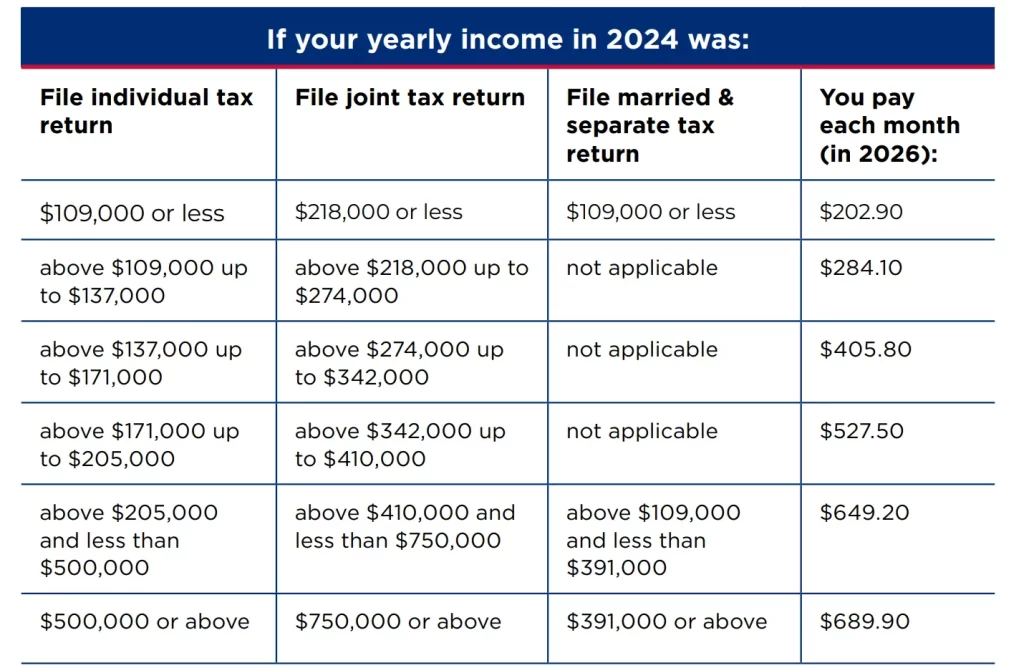
The "Part B premium" typically refers to the premium paid for Medicare Part B coverage. The premium amount can vary based on your income.
IRMAA
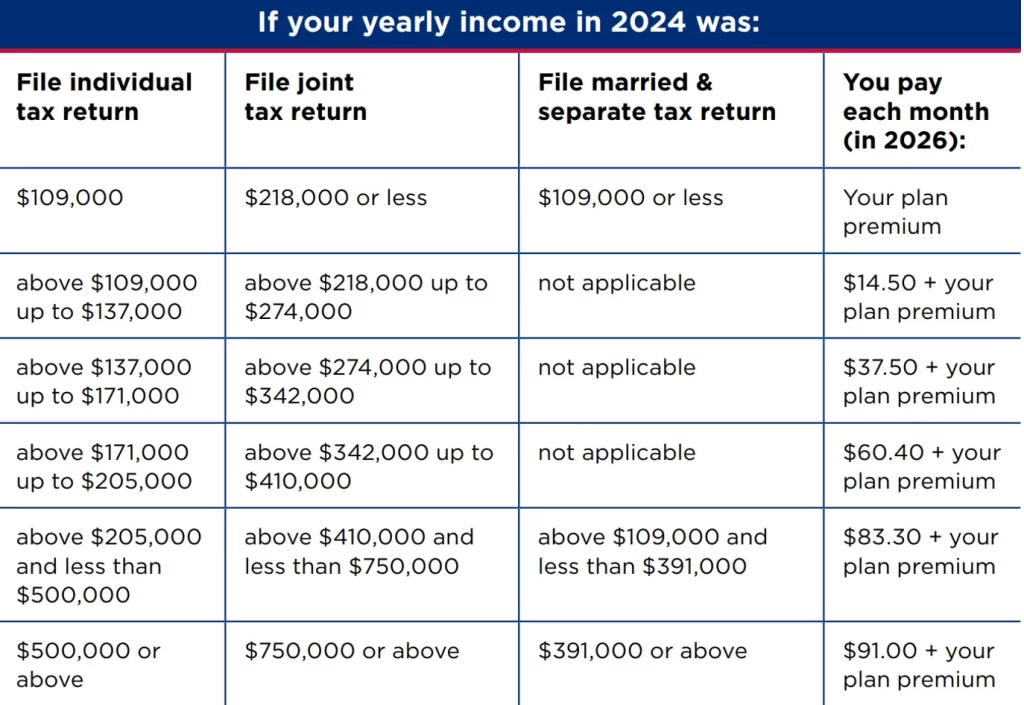
It's an additional cost that high-income Medicare beneficiaries may need to pay for their Part B & Part D premiums.
Part B Deductible
The Part B deductible is a fixed amount of money you must pay out of pocket for covered medical services before Medicare begins to pay its share.
Original Medicare Base Costs (Parts A & B)
Original Medicare consists of Parts A & B and forms the foundation of your coverage. Rates are adjusted annually by the federal government. Advisor Warning — The 20% Coinsurance Risk: Under Original Medicare alone, there is no Out-of-Pocket Maximum. If you require $150,000 in outpatient chemotherapy, surgery, or specialized therapy, your 20% share is $30,000 out-of-pocket. This financial exposure is why secondary coverage is essential.
| ORIGINAL MEDICARE BASE COSTS | |
|---|---|
PART A (Hospital Insurance)
|
|
PART B (Medical Insurance)
|
Part B Premium
The “Part B premium” typically refers to the premium paid for Medicare Part B coverage. The premium amount can vary based on your income. See IRMAA Chart Below Medicare will deduct your Part B premium from your Social Security every month if you are collecting Social Security benefits. If not, they will send you a quarterly bill.
The base Part B Premium for 2026 is $202.90
Part B Deductible
The Part B deductible is a fixed amount of money you must pay out of pocket for covered medical services before Medicare begins to pay its share. Medicare Part B covers outpatient services such as doctor visits, preventive care, and durable medical equipment. After you meet the deductible, Medicare typically pays 80% of the Medicare-approved amount for covered services, while you’re responsible for the remaining 20%.
The part B deductible for 2026 is: $283 annually

IRMAA
IRMAA stands for Income-Related Monthly Adjustment Amount. It’s an additional cost that high-income Medicare beneficiaries may need to pay for their Part B & Part D premiums. IRMAA is based on your modified adjusted gross income (MAGI) from two years prior. If your income exceeds certain thresholds, you may be subject to IRMAA, resulting in higher premiums for your Prescription Drug Plan and Part B coverage. If your income has dropped over previous years, you may appeal the cost basis and have your premium lowered to match your current income.
2026 IRMAA Limits (Income-Related Monthly Adjustment Amount)
| HOW IRMAA WORKS IN PRACTICE | |
|---|---|
| 1. THE 2-YEAR LOOKBACK | Your premiums are based on Modified Adjusted Gross Income (MAGI) from 2 TAX YEARS PRIOR. |
| 2. THE "CLIFF" EFFECT | Going $1 over a bracket threshold triggers the FULL monthly surcharge for the entire year. |
Part B IRMAA
Part D IRMAA
Appealing an IRMAA Surcharge: If your income dropped significantly due to a Life-Changing Event (such as retirement, marriage, divorce, or loss of income-producing property), you can file Form SSA-44 with Social Security to request a premium reduction based on your current income.
Comparing Private Plan Costs: Medigap, Advantage, and PDP
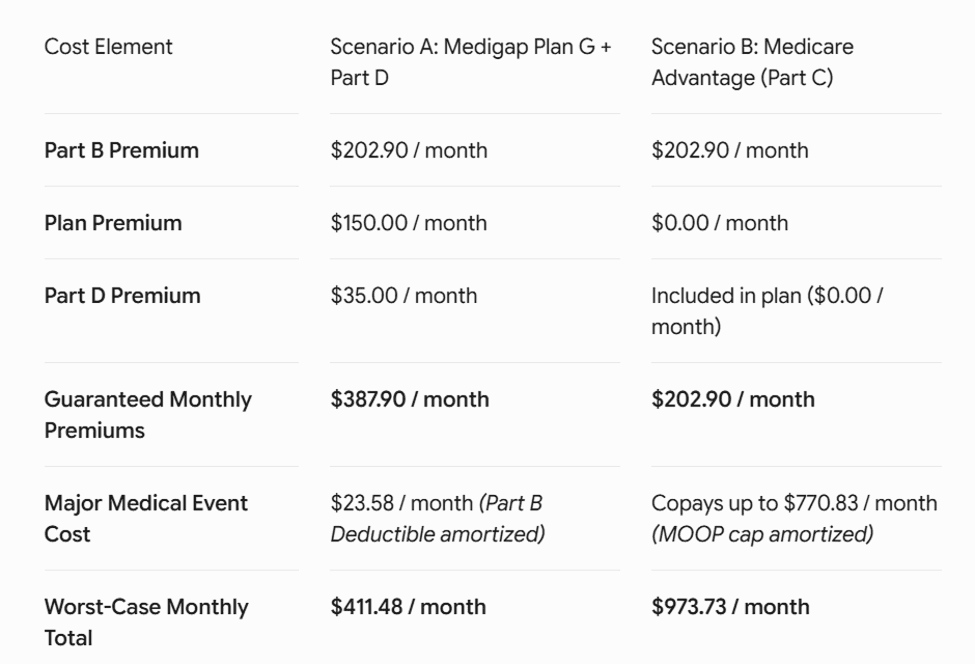
To protect against Original Medicare's gaps, enrollees select private plan add-ons. Here is how their cost models compare:
| 3 PRIVATE PLAN COST STRUCTURES | |
|---|---|
| 1. MEDIGAP (SUPPLEMENT) |
High fixed monthly premium ($120–$220+/mo). Near $0 out-of-pocket costs when receiving care. |
| 2. MEDICARE ADVANTAGE |
$0 or low monthly plan premium ($0–$40/mo). Pay-as-you-go copays up to annual max ($8k–$9k+). |
| 3. PART D DRUG PLANS |
Monthly plan premium ($0–$100+/mo). Max deductible ($615) + $2,100 out-of-pocket cap. |
1. Medicare Supplement (Medigap) Costs
- Monthly Premiums: Typically range from $120 to $220+ per month, depending on age, location, gender, and tobacco use.
- Out-of-Pocket Spending: Extremely low. Under a Plan G policy, your only out-of-pocket expense for Medicare-covered services is the $283 Part B annual deductible.
2. Medicare Advantage (Part C) Costs
- Monthly Premiums: Many regional plans carry a $0 monthly plan premium (you still pay your $202.90 Part B premium).
- Out-of-Pocket Spending: Pay-as-you-go. You pay copays for doctor visits ($5–$45), specialist visits ($35–$50), and daily hospital stays ($300–$400/day).
- Maximum Out-of-Pocket (MOOP): Federal rules cap annual in-network out-of-pocket spending (up to $9,250 per calendar year).
3. Prescription Drug Plan (PDP / Part D) Costs
- Monthly Premiums: Standalone Part D plans range from $0 to $100+ per month based on formulary tiering.
- Annual Deductible: Capped at a maximum of $615/year.
- Annual Out-of-Pocket Cap: Under the Inflation Reduction Act reforms, individual out-of-pocket prescription spending is strictly capped at $2,100 per year. Once you reach $2,100 in drug copays, your covered medications are paid at 100% for the rest of the year.
Total Annual Cost Scenario Comparisons
To visualize your potential financial commitment, compare two typical retiree profiles:
Frequently Asked Questions ?
Most individuals do not pay a monthly fee for Part A (Inpatient/Hospital Insurance) assuming they accumulated at least 10 years (40 quarters) of Medicare-taxed employment history. However, receiving inpatient care involves a $1,736 hospital deductible per benefit period.
For Part B (Outpatient/Medical Insurance), the standard baseline monthly fee is $202.90 (frequently subtracted directly from Social Security benefits), alongside an annual medical deductible of $283. Once you meet that deductible, Original Medicare covers 80% of approved medical charges, leaving you to pay the remaining 20% without a cap.
The Income-Related Monthly Adjustment Amount (IRMAA) is a federal rate increase applied to Part B and Part D premiums for individuals with higher income levels. Eligibility is evaluated using your Modified Adjusted Gross Income (MAGI) from tax filings two years prior.
Single tax filers declaring over $109,000 (or married couples filing jointly declaring over $218,000) see their Part B rates rise on a tiered scale, pushing total monthly premiums to anywhere between $284.10 and $689.90.
Requesting a Rate Re-Evaluation/Appeal: If your earnings dropped due to a life-altering event—such as retiring, losing a job, or experiencing a change in marital status—you can petition for a premium reduction by submitting Form SSA-44 directly to Social Security alongside supporting documentation.
No. Original Medicare (Parts A and B) features no built-in annual financial cap. If you incur extensive medical care or ongoing outpatient treatments, your 20% coinsurance obligation accumulates without an upper ceiling.
To protect against unlimited spending risks, beneficiaries typically choose one of two primary secondary coverage pathways:
- Medicare Supplement (Medigap): Adds a secondary policy to absorb Original Medicare’s deductibles and coinsurance gaps.
- Medicare Advantage (Part C): Replaces Original Medicare with an all-in-one private plan option that includes an explicit annual spending cap called MOOP (Max Out of Pocket.)
If you pass up enrollment during your initial eligibility period without maintaining verifiable, "creditable" health insurance (like active group health benefits through an organization employing 20 or more staff members), Medicare assesses lifelong penalties:
- Part B Surcharge: Adds a 10% premium fee for every full 12-month timeframe you were eligible but opted out. This added charge remains attached to your monthly payment permanently.
- Part D Surcharge: Calculated by multiplying 1% of the national base premium benchmark by the cumulative number of months you lacked recognized drug protection.
While core Original Medicare figures are established by federal agency mandates, private plans—including Medicare Advantage (Part C) and Standalone Part D Drug Coverage—regularly update their premiums, copays, pharmacy lists, and physician directories each year.
Every autumn, plan providers issue an Annual Notice of Change (ANOC) detailing terms for the coming year. Reviewing this document every fall ensures you aren't surprised by unexpected cost adjustments or network shifts come January 1.
Under updated pharmacy guidelines, out-of-pocket costs for covered medications are capped at $2,100 per calendar year. After your personal payments reach $2,100, your share drops to $0 for covered drugs through December 31.
Furthermore, if you face significant prescription costs early in the year, you can enroll in the Medicare Prescription Payment Plan (MPPP) to spread your pharmacy out-of-pocket expenses into manageable, interest-free monthly installments.
Credentials & Compliance
Written by: MediPlans NJ
Credentials: Licensed Independent Health & Medicare Insurance Advisors
Regulatory Compliance: Fully Compliant with Centers for Medicare & Medicaid Services (CMS) Guidelines
Editorial Integrity: MediPlans NJ operates as an independent advisory firm. We offer objective, non-biased comparisons across multiple top-rated Medigap carriers to help you protect your healthcare freedom without overpaying.

Make Sense of Medicare Costs
Get personalized guidance on Medicare costs and IRMAA so you can make informed decisions about your coverage.