

Medicare Supplement Plans
Medicare Supplement Plans, also known as Medigap, help cover out-of-pocket costs such as deductibles, coinsurance, and copayments that Original Medicare doesn’t fully cover. We’ll help you understand your options and find the plan that best suits your needs and budget.

Get guidance on the first steps to explore your Medicare options.
Understand your choices and how employer coverage may impact enrollment.
Learn the enrollment process, timelines, and important information.
Compare Medicare coverage choices to find the right fit for you.
Get clarity on Medicare costs and how to plan for your healthcare expenses.

Understanding Medicare Supplement (Medigap) Plans: An Advisor’s Comprehensive Guide
While Original Medicare (Parts A and B) provides strong foundational coverage, it was never designed to cover 100% of your medical bills. It leaves noticeable "gaps"—including a $1,736 Part A hospital deductible, a $283 Part B annual deductible, and an uncapped 20% coinsurance on doctor visits, outpatient surgeries, and medical tests.
Medicare Supplement Insurance, commonly called Medigap, is private insurance designed specifically to fill those financial gaps. With a Medigap policy, you maintain complete freedom to choose your healthcare providers while insulating yourself against unexpected medical expenses.
The 3 Universal Rules of Medigap Insurance
The chart below shows basic information about the different benefits Medigap policies cover.
| THE 3 CORE LAWS OF MEDIGAP | |
|---|---|
| 1. PLANS ARE STANDARDIZED | A Plan G with Carrier A has the exact same medical benefits as Plan G with Carrier B. |
| 2. NATIONWIDE DOCTOR ACCESS | You can see ANY doctor or hospital in the US that accepts Original Medicare (No networks). |
| 3. GUARANTEED RENEWAL | Policies cannot be canceled due to health changes as long as you pay your premiums. |
Before choosing a plan, it helps to understand how the federal government regulates Plans Are Standardized by Letter: The federal government standardizes Medigap plans by letters (A, B, C, D, F, G, K, L, M, N). This means Plan G benefits are 100% identical regardless of which insurance carrier sells it. The only differences between companies are the monthly premium, household discounts, and rate stability.
- No Managed Care Networks: Medigap does not use HMO or PPO networks. If a doctor or hospital accepts Original Medicare, they must accept your Medigap plan, regardless of the insurance company on your card.
- Guaranteed Renewable: As long as you pay your monthly premium on time, an insurance company can never drop your policy or reduce your benefits due to new health conditions.
2026 Medigap Benefits Comparison Chart
The chart below illustrates what each standardized Medigap letter covers:
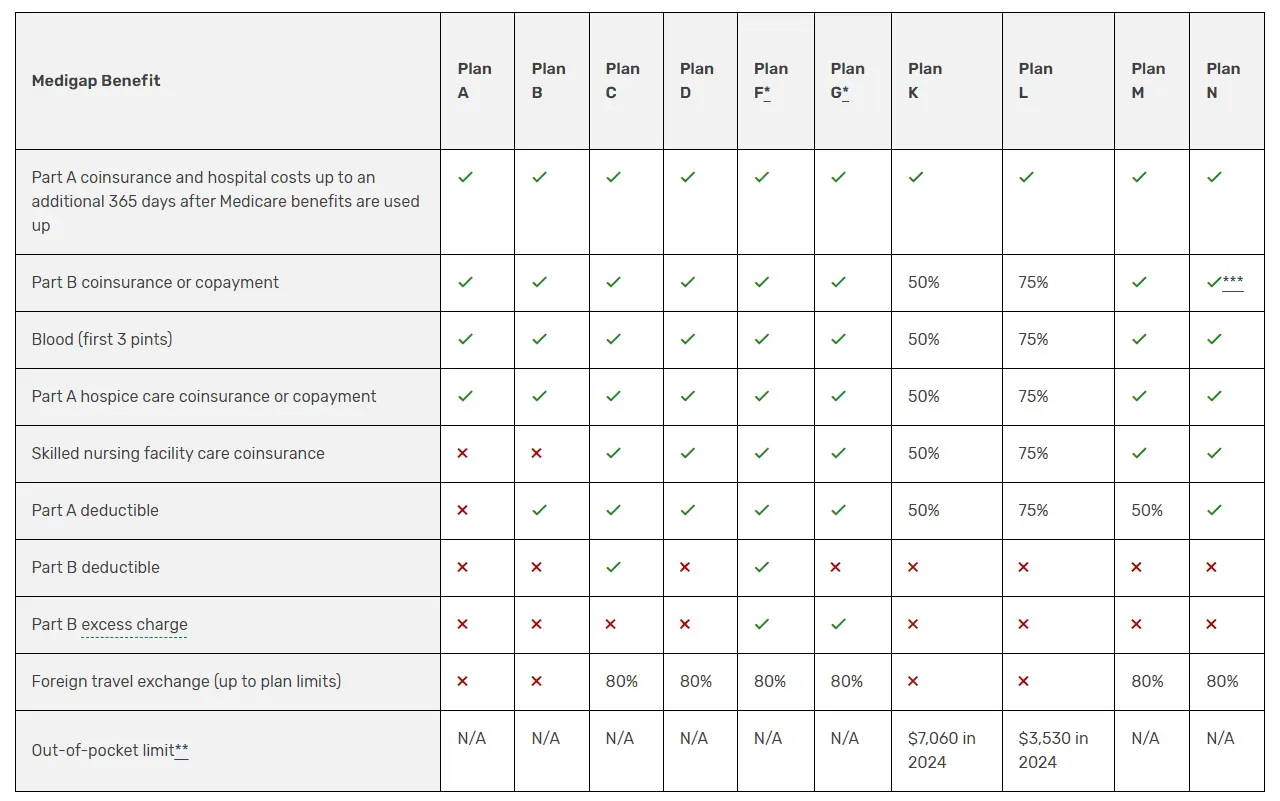
*Plans C and F are legacy plans only available to individuals eligible for Medicare before January 1, 2020. A High-Deductible Plan G option is also available in most states.
Plan N pays 100% of Part B coinsurance, except for small copays of up to $20 for office visits and $50 for ER visits that don't lead to inpatient admission.
The 2 Most Popular Medigap Plans Breakdown
While there are 10 standardized plans, the vast majority of new Medicare beneficiaries select between Plan G and Plan N.
PLAN G vs. PLAN N SHOWDOWN
PLAN G
"Comprehensive Peace of Mind"
Pays 100% of gaps after the Part B deductible ($283).
Covers Part B Excess Charges.
Zero out-of-pocket costs at the doctor.
PLAN N
"Lower Premium Alternative"
Lower monthly premiums.
$0–$20 doctor copays.
Does not cover Part B Excess Charges.
Great for generally healthy seniors.
Plan G: Comprehensive Protection
Plan G is considered the standard choice for new Medicare enrollees. It covers every single gap in Original Medicare with just one exception: the annual Part B deductible ($283). Once you pay your $283 Part B deductible at the doctor's office for the year, Plan G pays 100% of all covered medical bills for the rest of the calendar year.
Plan N: Value & Lower Premiums
Plan N is a budget-friendly option that offers lower monthly premiums in exchange for taking on minor cost-sharing:
- You pay the annual Part B deductible ($283).
- You pay a copay of up to $20 for office visits.
- You pay a $50 copay for emergency room visits (waived if admitted).
- You cover Part B Excess Charges if a doctor does not accept "Medicare Assignment" (a rare occurrence where doctors charge up to 15% above Medicare rates).
When to Buy: The Medigap Open Enrollment Window
Timing is the single most critical factor when applying for a Medicare Supplement policy.
| THE 6-MONTH MEDIGAP OPEN ENROLLMENT | ||
|---|---|---|
| Starts the month your Medicare Part B goes active (Age 65+). GUARANTEED ISSUE: No health questions, medical exams, or underwriting. Insurance companies CANNOT deny you or charge higher premiums for pre-existing health conditions. |
||
Critical Warning — Medical Underwriting:
If you apply for a Medigap plan outside your 6-month Open Enrollment Period (or outside a qualifying Special Rights window), insurance companies are legally allowed to ask about your medical history, review your prescription history, and deny you coverage or charge higher rates for pre-existing health conditions.

Commonly Asked Questions About Medicare Supplement/Medigap:
The cost of Medicare supplements, or Medigap plans, can vary depending on several factors, including:
1. Location: The cost of healthcare services can vary by region, so the price of Medigap plans may also vary depending on where you live.
2. Insurance Company: Different insurance companies offer Medigap plans at different prices. It’s essential to compare plans from various insurers to find the best price for your needs.
3. Plan Type: There are several standardized Medigap plans, labeled with letters (e.g., Plan N, Plan G, etc.). The costs can vary depending on the specific benefits provided by each plan. Generally, plans with more comprehensive coverage will have higher premiums.
4. Age: Insurance companies may base their premiums on your age, with rates potentially increasing as you get older.
On average, Medicare supplement premiums can range from around $100 to $300 or more per month. It’s crucial to research and compare plans carefully to find one that fits your budget and healthcare needs. Additionally, it’s wise to consider any potential rate increases over time when choosing a plan.
The most comprehensive Medicare supplement plan is often considered to be Plan F. However, Plan F is no longer available to new Medicare beneficiaries who became eligible for Medicare on or after January 1, 2020. Instead, the most comprehensive plan currently available is Plan G.
Plan G offers nearly identical coverage to Plan F, except for one difference: it does not cover the Medicare Part B deductible. Once you meet the Part B deductible for the year, Plan G covers the remaining Medicare-approved costs at 100%. This makes it an extremely comprehensive plan, providing coverage for most, if not all, out-of-pocket expenses associated with Medicare-covered services.
Other comprehensive plans include Plan C, Typically for those under 65 on disability, this is also no longer available to new Medicare beneficiaries who became eligible for Medicare on or after January 1, 2020, and Plan D. These plans offer similar coverage to Plan G but may have different premium costs.
It’s essential to carefully consider your healthcare needs and budget when choosing a Medicare supplement plan, as the most comprehensive plan may not always be the best option for everyone. Additionally, plan availability and coverage options can vary by location and insurance provider.
No. Modern Medigap policies sold today do not include outpatient prescription drug coverage. To get prescription coverage, you should pair your Medigap policy with a standalone Medicare Part D plan.
Standard Medigap plans do not cover routine dental cleanings, eyeglasses, or hearing aids. However, many policyholders purchase separate private dental/vision riders or standalone policies to cover these needs.
Yes, you can apply to switch Medigap plans at any time of the year. However, unless you qualify for a Guaranteed Issue right or live in a state with special rules (like a Birthday Rule), you will generally need to pass health qualification questions (medical underwriting) to change policies.
Official Administrative & Government Links
Official Medicare.gov – Medigap Policy Search(opens in new tab)
Credentials & Compliance
Written by: MediPlans NJ
Credentials: Licensed Independent Health & Medicare Insurance Advisors
Regulatory Compliance: Fully Compliant with Centers for Medicare & Medicaid Services (CMS) Guidelines
Editorial Integrity: MediPlans NJ operates as an independent advisory firm. We offer objective, non-biased comparisons across multiple top-rated Medigap carriers to help you protect your healthcare freedom without overpaying.

Find the Right Supplement Coverage
Explore your Medicare Supplement options with personalized guidance from MediPlans NJ.